Cost transparency is rare in the high-end 3D animation market. Studios working at the Maya production standard tend toward vague pricing language — ‘project-dependent,’ ‘contact us for a quote’ — that reflects genuine scope variability but also leaves buyers without any meaningful framework for evaluating whether a studio’s pricing is fair, appropriate, or aligned with market rates.
This article addresses that gap. It provides an honest, detailed pricing framework for Maya-based 3D animation production in the U.S. market as of 2026 — calibrated to the production standard that a genuine Maya pipeline with Arnold rendering and professional artist teams actually delivers. It explains the cost drivers specific to high-end production, maps pricing to project type and complexity tier, and gives buyers the tools to evaluate quotes accurately and compare studios on value rather than headline rate alone.
The goal is not to produce a price list — scoped production varies too widely for a price list to be useful. The goal is to give you the analytical framework to understand any quote you receive from a professional Maya studio, and to identify misalignments between claimed capability and stated pricing.
Why Maya-Based Production Costs More Than Standard 3D Animation

The pricing premium of Maya-based production over standard 3D animation reflects genuine cost differences across every component of the production pipeline. Understanding these differences is the prerequisite for evaluating pricing fairly.
Software and Infrastructure Cost
Autodesk Maya is a professional subscription software with per-seat annual licensing costs that are significant relative to the free and low-cost alternatives that lower-priced studios use. Arnold renderer, now bundled with Maya, adds additional per-render-node licensing cost at production scale. A professional Maya studio’s software overhead alone — across a team of four to eight artists — represents a meaningful fixed cost that is reflected in production pricing.
Beyond software, the render farm infrastructure required to produce high-quality Arnold renders within commercial production timelines represents either significant capital investment in on-premises hardware or ongoing cloud rendering costs. Frame-for-frame, Arnold at production quality settings requires substantially more compute than real-time or game-engine rendering — and that compute cost is real.
Artist Expertise and Specialization
The artists who produce professional Maya animation are specialists — riggers, lighters, animators, and technical directors who have invested years in mastering specific pipeline disciplines at production standard. This specialization is expensive to hire and to maintain. A senior Maya lighter with Arnold expertise commands a market rate that reflects their skill’s scarcity and the quality differential they produce. A generalist 3D artist producing in a free tool does not command the same rate — and does not produce the same output.
At a professional Maya studio, different pipeline phases are typically handled by different specialists: a modeler for geometry, a technical director for rigging, an animator for motion, a lighter for the rendering environment. This team structure produces better output than a single generalist approach — and costs more, because multiple specialist artists are contributing to each project.
Production Management and Quality Assurance
Professional Maya productions require structured project management: milestone planning, asset version control, render management, QA review before each client delivery, and delivery documentation. The overhead of running a professional production at this level — a dedicated project manager, quality review processes, and the administrative infrastructure of a commercial studio — is a real cost that is reflected in pricing. It is also the difference between a production that delivers reliably and one that does not.
| When evaluating a quote from a Maya studio, the question is not whether the price is higher than alternatives — it almost certainly is. The question is whether the premium reflects genuine production capability that will be visible in the output. |
Pricing Framework by Project Type and Complexity
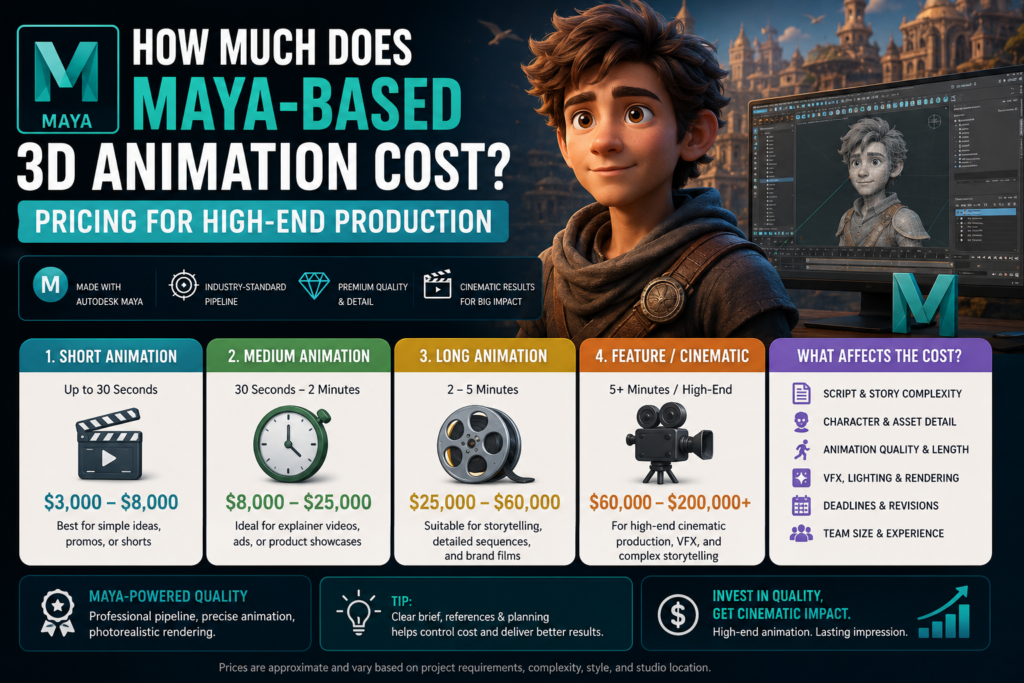
The following framework maps Maya-based 3D animation to indicative pricing ranges in the U.S. market. These are professional studio rates — not freelance rates, not offshore rates, not rates produced by generalist studios using Maya incidentally. They reflect what a genuine Maya production operation charges for the work described.
| Project Type and Scope | Indicative U.S. Studio Rate (2026) |
| Product visualization — single product, simple geometry, neutral environment, 15–30 sec, Arnold photorealistic | $8,000 – $18,000 |
| Product visualization — complex geometry or mechanism, branded environment, 30 sec, multiple variants | $18,000 – $40,000 |
| Product visualization — premium, multi-scene, VFX elements (fluid, particles), 30–60 sec | $35,000 – $75,000 |
| 3D explainer — 60–90 sec, character or product focus, 3–5 scenes, Arnold lighting, full audio | $18,000 – $40,000 |
| Brand commercial — 30–60 sec, cinematic quality, multiple environments, simulation elements | $50,000 – $120,000 |
| Cinematic brand film — 60–90 sec, VFX-quality production, character performance, full pipeline | $90,000 – $220,000+ |
| Architectural visualization — exterior + interior renders package (8–12 stills), Arnold | $12,000 – $30,000 |
| Architectural walkthrough — 60–90 sec animated, exterior + interior, photorealistic Arnold | $25,000 – $60,000 |
| Medical / scientific visualization — 60–90 sec, biological or mechanical accuracy, Arnold | $20,000 – $55,000 |
| Character animation — 30–60 sec, Maya rig, expressive performance, single character | $25,000 – $65,000 |
| VFX sequence (standalone) — 5–15 sec simulation element (fluid, particles, cloth, destruction) | $12,000 – $35,000 |
| Enterprise training animation — per module (3–5 min), technical accuracy, full production | $35,000 – $80,000 |
The Variables That Move Price Within Each Range

The ranges above are wide because the cost of any specific project is determined by a combination of scope variables that interact in non-linear ways. Understanding these variables allows buyers to anticipate where their project falls within its relevant range and to evaluate studio quotes accurately.
Geometric Complexity of the Primary Asset
A product with simple geometric forms — a cylindrical bottle, a rectangular consumer electronics device — requires significantly less modeling time than a product with complex surface geometry, intricate mechanical components, or fine surface detail that must be represented accurately at close camera distances. Complex geometry extends the modeling phase and may require additional UV mapping and texturing work to maintain accuracy across the model’s entire surface.
Number of Unique Assets
Every unique object in the animation — every distinct product, character, environment element, or prop — requires its own modeling and texturing work. A production with one hero product in three environments is more expensive than a production with the same hero product in one environment, because each environment requires unique set modeling and lighting. Scope briefing that clarifies exactly how many unique assets the animation requires enables more accurate quoting.
Simulation Complexity
The presence of simulation elements — fluid dynamics, cloth, particles, rigid body destruction — adds a distinct production phase with its own time and expertise cost. A fluid simulation that requires multiple iterations to achieve the visual behavior specified in the brief may add one to three weeks of technical director time to the production. Brief clearly about simulation requirements to ensure they are fully scoped in the quote.
Character Rigging Scope
Character animation in Maya is priced substantially differently from product or environmental animation because of the rigging phase. A simple character with basic body movement requires a relatively lightweight rig. A character with full facial control systems, secondary simulation (hair, clothing), and expressive performance requirements requires a production-grade rig that may take two to four weeks to build independently of the animation itself.
Rendering Quality and Duration
The relationship between render quality and production cost is direct: higher sample counts per pixel produce cleaner, more photorealistic renders and require proportionally more compute time. A 60-second animation at cinema-quality Arnold settings may require twenty times the compute of the same animation at standard commercial settings. At large render farm billing rates, this difference is commercially significant. Brief specifically about the quality standard required — broadcast, web, or social — as each implies different rendering specifications.
Comparing Quotes: What to Look For
When comparing quotes from Maya studios at the premium production level, headline price comparison is an insufficient evaluation tool. The following framework enables a quality-adjusted comparison.
| Evaluation Criterion | What to Ask and Look For |
| Scope specificity | Does the quote map its line items to specific deliverables, production phases, and revision inclusions? A vague quote that lumps everything into a single line is a red flag. |
| Rendering specification | Does the quote specify the render quality settings (samples per pixel, ray depth, denoising approach)? Lower settings produce faster delivery and lower cost — but visibly lower output quality. |
| Asset ownership clarity | Does the quote include explicit delivery of 3D project files and source assets? If not, ask. Retaining source files after delivery is a studio practice that limits the client’s flexibility. |
| Revision policy | How many rounds of revision are included at each milestone, and at what rate are additional rounds billed? Studios with unlimited revisions built into their quote are pricing the risk into the base rate. |
| Team composition | Who specifically will be working on this project? A senior Maya technical director and specialist lighter produce different output than junior generalists using the same software. |
| Portfolio alignment | Is the studio’s portfolio work representative of the quality being quoted? Does the work in the portfolio show Arnold-rendered photorealism, professional rigging, and simulation capability that matches what you are commissioning? |
The Investment Case for Maya-Standard Pricing
The premium of Maya-standard production over lower-cost alternatives is real. It is also, for the projects where it is appropriate, commercially justified by the output quality differential and its downstream commercial impact.
A photorealistic product animation produced at Maya and Arnold standard that is visually indistinguishable from photography converts e-commerce visitors at a measurably higher rate than a lower-quality equivalent. A cinematic brand film produced at VFX standard generates brand perception uplift that a standard commercial animation does not. An architectural visualization that accurately simulates natural light behavior closes pre-sales that a schematic render would leave uncertain.
The investment case for Maya-standard pricing is not that it is the right choice for every project. It is that for the projects where visual quality is the primary commercial variable — where the output’s quality directly determines its commercial performance — the premium is justified by the return it generates.
3D Animation Maya is a professional Maya studio serving clients across the United States who require production at the standard this pricing reflects. Contact our team for a detailed, scope-specific quote on your project — we will give you a precise investment figure, not a range, once we understand your brief.