
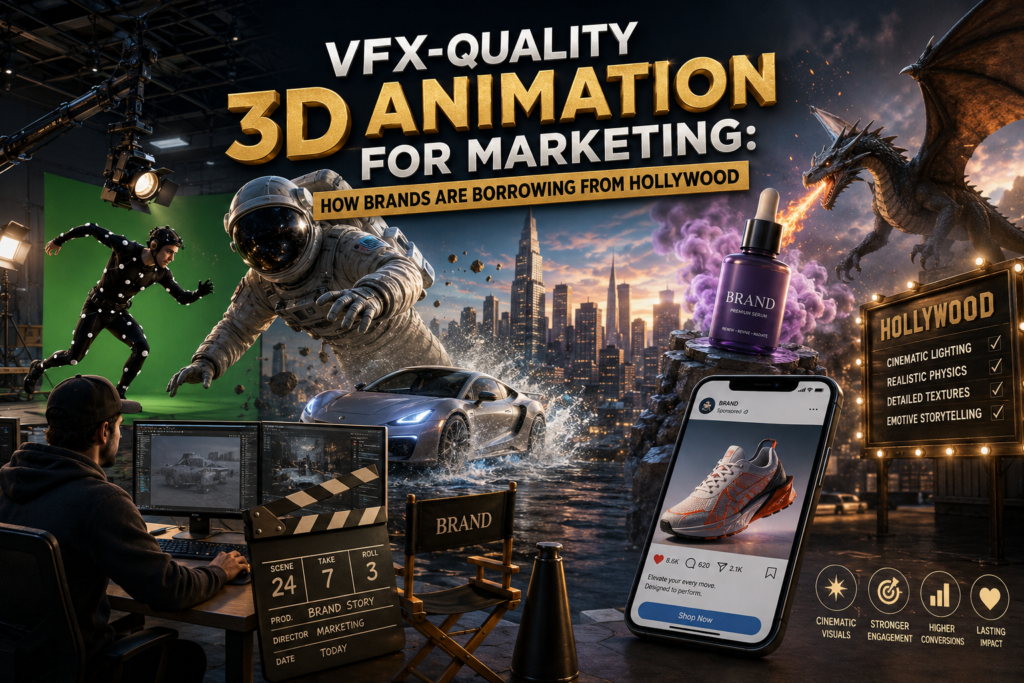
For most of advertising history, the visual effects techniques developed for film and television production were inaccessible to brand marketing campaigns — either because the cost of the technology was prohibitive, or because the production infrastructure required to execute them was concentrated in specialist VFX houses serving the entertainment industry.
That boundary has dissolved. The tools, techniques, and pipeline standards that produce the visual effects sequences in blockbuster cinema are now accessible to brand marketing campaigns — through studios that operate professional Maya pipelines, run production-grade Arnold rendering, and employ artists who have trained in the same production environment as Hollywood’s major VFX houses. The visual effects that audiences associate with cinematic storytelling are being deployed in product commercials, brand films, and advertising campaigns with increasing frequency — and producing a category of marketing content that competes for attention on entirely different terms from standard creative.
This article explains what VFX-quality 3D animation means in a marketing context, which visual effects techniques are most commercially effective for brand campaigns, how Maya enables them at production standard, and what brands need to invest to access this tier of output.
What ‘VFX-Quality’ Means in Brand Animation
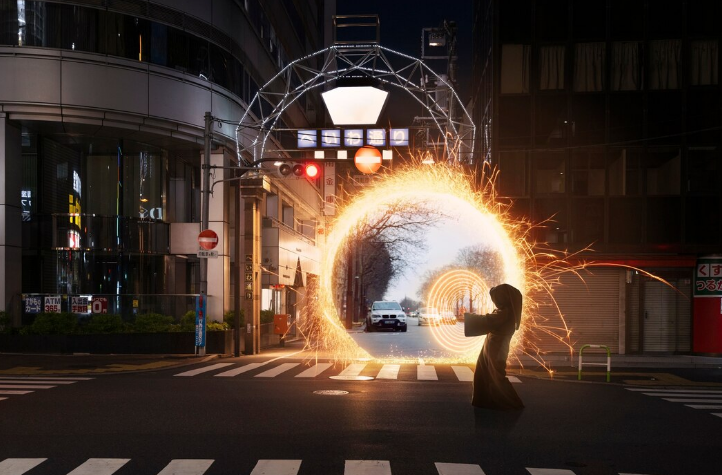
VFX-quality is not a casual description — it is a specific production standard defined by the visual effects industry’s own benchmarks: the level of realism, physical accuracy, and technical execution required for content that will appear alongside the work of ILM, Weta FX, and Moving Picture Company in the editorial judgement of professionals who have produced both.
In practice, VFX-quality brand animation is characterized by visual elements that would be recognized by a professional VFX artist as meeting production standard — not just visually impressive to a lay audience, but technically correct in ways that only practitioners and discerning viewers notice:
- Physically accurate fluid simulations that respond to virtual forces with the viscosity, surface tension, and behavior of real liquid
- Cloth and soft-body dynamics where fabric, hair, or deformable materials move with the mass, stiffness, and aerodynamic response of their physical equivalents
- Volumetric effects — smoke, fog, atmospheric haze, fire — produced through voxel-based simulation rather than composited stock footage
- Particle systems that behave as collections of individual physical objects — dispersing, coalescing, reacting to forces — rather than as stylized graphic effects
- Photorealistic rendering where every surface material’s response to light is physically plausible at a level that passes close scrutiny
- Camera work that applies the optical characteristics of real lenses — depth of field, chromatic aberration, lens flare — in a physically motivated way
| The difference between VFX-quality animation and high-quality standard animation is not the presence of impressive visuals. It is the physical accuracy of those visuals — the degree to which they obey the laws of the real world rather than approximating them. |
The VFX Techniques Most Valuable in Brand Marketing

Not all VFX techniques transfer equally to brand marketing applications. The following are the simulation and effects disciplines that produce the highest commercial value in marketing contexts — the ones that create visual sequences that are genuinely impossible to produce in live-action and that generate the category-defining quality signal brands commission them for.
Fluid Dynamics: Liquid, Pour, and Flow
Fluid simulation is among the most commercially deployed VFX technique in brand marketing — particularly for food and beverage, cosmetics, personal care, and pharmaceutical advertising. A photorealistic liquid pour, a product submerging in fluid, ingredients mixing, a cream spreading — these are visual sequences that live-action can attempt but simulation produces with a level of control and visual precision that physical filming cannot match.
In Maya’s Bifrost simulation environment, fluid dynamics are computed using a physically-accurate solver that reproduces the behavior of real liquids at the scale and viscosity specified. The result is a fluid simulation that responds to the virtual environment’s geometry and forces — the shape of a vessel, the direction of a pour, the surface it lands on — with the physical authenticity of a real liquid, combined with the creative control that no physical set can provide.
For brands in categories where the sensory appeal of their product is expressed through liquid behavior — the pour of a premium spirit, the lather of a skincare formulation, the spread of a sauce — VFX-quality fluid simulation is the production standard for their highest-investment marketing content.
Particle Systems: Dispersion, Assembly, and Transformation
Particle system effects — where a substance, a product, or a concept is depicted as a collection of individual particles that disperse, assemble, flow, or transform — are among the most visually distinctive techniques in brand marketing VFX. The effect has been used to depict product disassembly into component ingredients, brand concepts materializing from scattered elements, technology products assembling from digital particles, and scientific phenomena made visible at human scale.
In Maya, particle systems are produced using the Bifrost visual programming environment or Maya’s nParticle system, which allows millions of individual particles to be simulated as physical objects with defined mass, velocity, drag, and collision behavior. The resulting animations have a visual complexity and physical credibility that composited graphic effects cannot achieve — the particles move as individual physical objects, not as a synchronized graphic pattern.
Cloth and Fabric Simulation
Cloth simulation is the VFX technique that makes fabric — garments, drapery, flags, packaging materials — move with the weight, stiffness, and aerodynamic response of the real material it represents. In brand marketing, this technique is used in fashion and luxury goods advertising, packaging animations where flexible materials are featured, product environments where fabric elements establish atmosphere, and character animation where clothing performance is part of the visual quality.
Maya’s nCloth system simulates fabric as a mesh of connected particles with defined material properties — stiffness, damping, friction, and mass — that respond physically to the forces applied to them. A garment simulated in Maya’s nCloth moves with the visual authenticity of a real fabric in real air — not the simplified, cycled animation that non-simulation cloth production produces.
Destruction and Transformation Effects
Destruction effects — objects breaking, shattering, fragmenting, exploding, or dissolving — and their inverse, construction and assembly sequences, are among the most dramatically effective visual elements in brand advertising. The transformation of a product from raw materials to finished form, a competitive product being visually replaced by the advertised brand, a problem being eliminated to reveal a resolved state — these narrative arcs are a core vocabulary of brand VFX work.
In Maya, destruction and transformation effects are produced through a combination of rigid body dynamics, fracture simulations, and particle systems. The result is destruction or construction that behaves physically — objects break along realistic fracture patterns, debris scatters with correct trajectory physics, fragments come to rest with appropriate bounce and friction behavior.
Volumetric and Atmospheric Effects
Smoke, fog, mist, fire, and atmospheric haze create the environmental depth and atmospheric quality that distinguish cinematic visual treatment from standard 3D renders. In brand marketing, these effects are used to establish premium atmospheres — the steam rising from a hot beverage, the mist in a luxury fragrance environment, the atmospheric haze of a landscape setting — and to create visual transitions and spatial depth that elevate the production quality of a scene.
Arnold’s volumetric rendering capabilities produce volumetric effects with physically-based light scattering — the way light behaves as it passes through a volume of participating media. The result is smoke, fog, and atmospheric effects that are lit by the scene’s actual light sources, casting and receiving light and shadow in a physically accurate way.
How Maya Enables VFX-Quality Production for Brand Campaigns
The reason VFX-quality brand animation is produced in Maya is not convention — it is capability. The simulation systems, rendering infrastructure, and production pipeline that VFX-quality work requires are mature in Maya in ways they are not in alternative tools.
| VFX Capability | Maya Production Tool | Commercial Application |
| Fluid simulation | Maya Bifrost fluid solver | Beverage pours, cosmetics formulation, pharmaceutical liquid, cleaning products |
| Particle systems | Bifrost / nParticle with physical properties | Product assembly, ingredient dispersion, technology visualization, sci-fi/abstract effects |
| Cloth dynamics | Maya nCloth — physically-based fabric simulation | Fashion, luxury goods, packaging with flexible materials, character garments |
| Rigid body destruction | Maya Bullet physics / Bifrost fracture | Product transformation, competitive displacement narratives, dramatic reveals |
| Volumetric effects | Arnold volume rendering — physically-based scatter | Atmospheric environments, fragrance marketing, food steam, fire and smoke |
| Character effects — hair/fur | Maya XGen / nHair with dynamics | Character realism, animal visualization, premium product texture representation |
What VFX-Quality Brand Animation Costs — and Why

VFX-quality brand animation commands a significant production premium over standard commercial 3D animation, and understanding why helps brands evaluate whether the investment is appropriate for their specific brief.
The cost drivers of VFX-quality production are primarily time and expertise. Fluid simulations require significant compute time to produce at high resolution and physical accuracy — and multiple simulation iterations as the creative team refines the behavior to match the intended visual result. Character effects and cloth dynamics require technical artists with specialist simulation expertise. Volumetric rendering at high quality settings is computationally intensive. The supervision, iteration, and refinement required to bring a VFX sequence to production standard on a commercial brief is measured in weeks of senior artist time, not days.
| Production Scope | Indicative Investment Range |
| Single VFX sequence (5–10 sec), e.g., one fluid pour or particle dispersion integrated into a larger production | $15,000 – $35,000 for the VFX element |
| Short VFX-led commercial (15–30 sec), VFX as primary visual element | $40,000 – $100,000 |
| Full VFX brand film (60–90 sec), multiple VFX disciplines integrated | $80,000 – $200,000+ |
| Enterprise campaign with VFX hero film and campaign derivatives | $150,000 – $400,000+ |
These ranges reflect professional studio production at VFX quality standard in the U.S. market in 2026. They are not the rates of generalist studios applying VFX-adjacent effects — they reflect the cost of genuine simulation-based production at the technical standard the term implies.
Is VFX-Quality Right for Your Campaign?
VFX-quality animation is the right investment when the commercial objective requires the specific visual capabilities that VFX production uniquely provides — and when the production budget can support the investment those capabilities require. It is not the right investment for every campaign, and brands that commission VFX production for briefs that standard commercial animation would serve equally well are spending money on capability they are not actually using.
The briefs where VFX-quality investment is most clearly justified are those where the product’s appeal is expressed through physical behavior (fluid, fabric, transformation), where the creative concept requires visual sequences that are physically impossible to film, or where the brand’s positioning as a premium category leader demands visual content that operates at the absolute ceiling of production quality.
3D Animation Maya produces VFX-quality brand animation for marketing campaigns across the United States — using Maya’s simulation and rendering capabilities to deliver visual sequences that set the standard their categories are measured against. Contact our team to discuss whether VFX-quality production is the right investment for your next campaign.