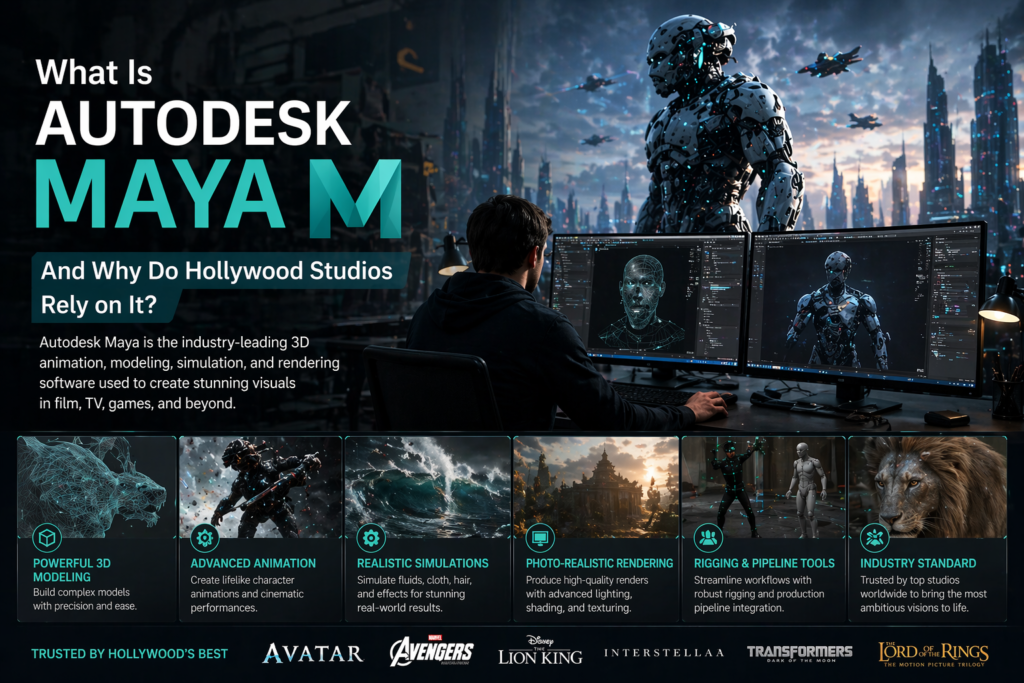
Every major visual effects sequence in blockbuster cinema. The character animation in globally released feature films. The photorealistic product commercials that run during the Super Bowl. The architectural visualizations that sell billion-dollar real estate developments before a foundation has been poured. A significant proportion of the professional 3D animation and visual effects work that has defined the industry for three decades shares a common thread: it was produced in Autodesk Maya.
Maya is not simply a 3D software application. It is the production environment around which the professional animation and VFX industry has organized itself — the tool that leading studios invest in, that professional artists spend years mastering, and that commercial clients increasingly recognize as a mark of production seriousness. Understanding what Maya is, what it does, and why it holds its dominant position requires looking at both its technical architecture and the industry ecosystem that has grown around it.
This article is written for business buyers and marketing decision-makers who want to understand what they are working with when they engage a Maya-based studio — and why that distinction matters for the quality of their output.
What Is Autodesk Maya?
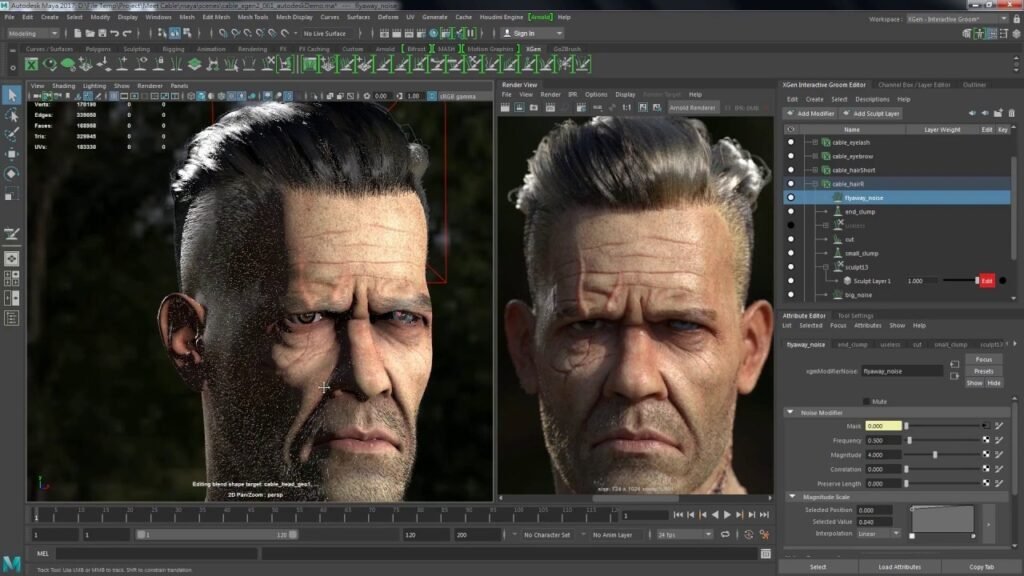
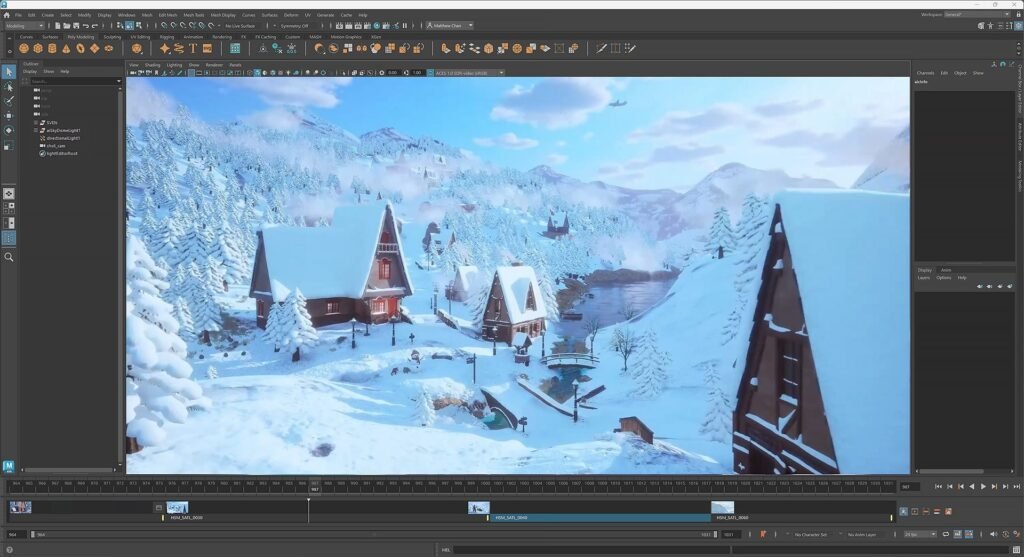
Autodesk Maya is a comprehensive professional three-dimensional computer graphics application used for 3D modeling, rigging, animation, simulation, lighting, rendering, and compositing. It operates on a node-based architecture — a system in which every element of a 3D scene is represented as a node with defined inputs and outputs, and complex behaviors are created by connecting these nodes in a network. This architecture is what gives Maya its extraordinary flexibility and power for complex, professional-grade production work.
Maya was originally developed by Alias Systems Corporation, drawing on earlier technologies from Alias and Wavefront. It was released in 1998 and acquired by Autodesk in 2006. In the nearly three decades since its initial release, it has undergone continuous development and remains not only current but dominant in the professional production landscape.
The software runs on Windows, macOS, and Linux, and is available through Autodesk’s subscription model. It is used by individual artists, small specialist studios, and the largest VFX and animation houses in the world.
What Maya Is Used For: The Professional Applications
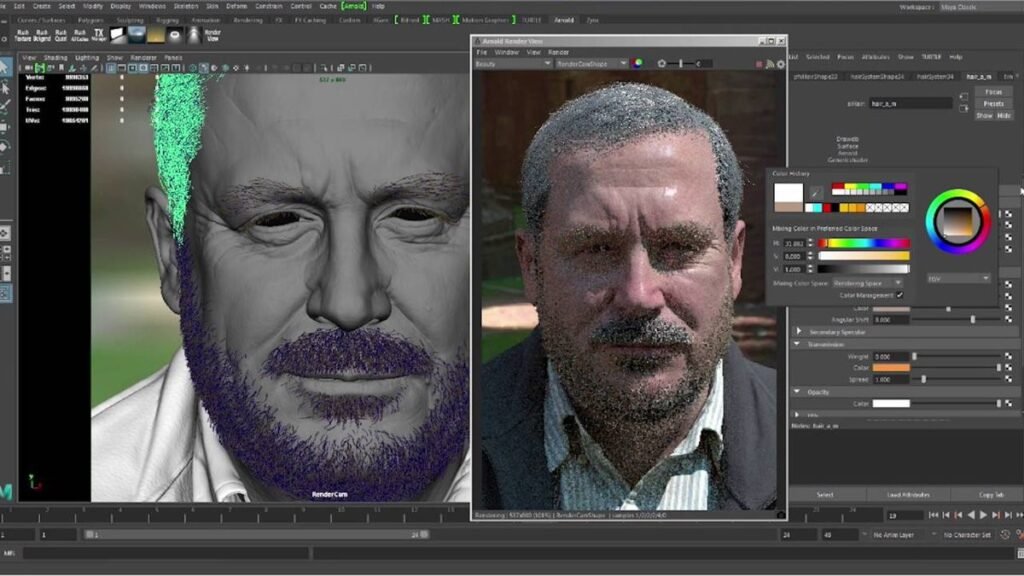
Maya’s capabilities span every major discipline of professional 3D production. Understanding each application area helps business buyers identify where Maya’s specific strengths are most commercially relevant to their projects.
Character and Creature Animation
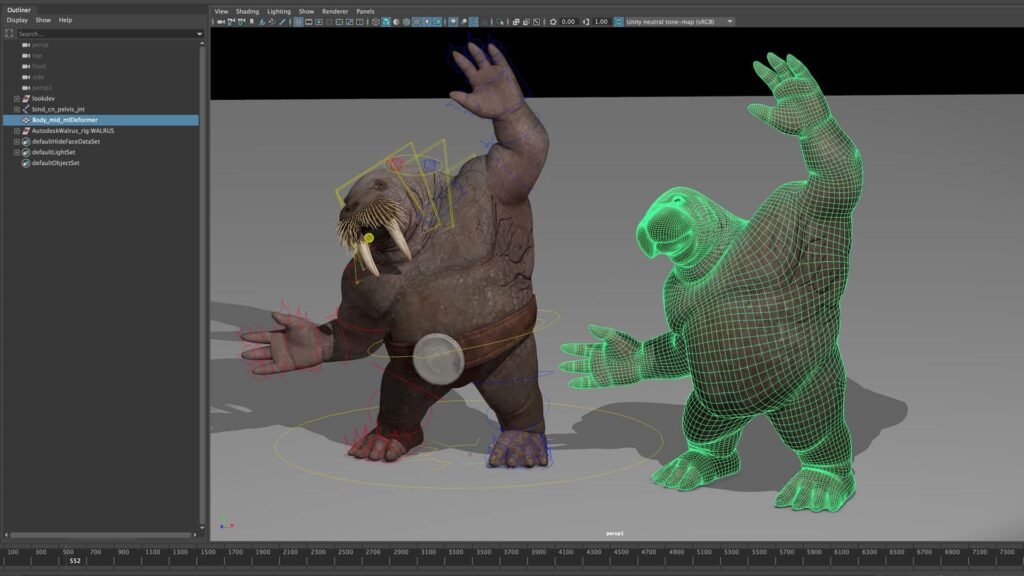
Maya is the dominant tool for professional character and creature animation in both film and commercial production. Its rigging system — the process of creating the skeletal and control structures that allow a digital character to move — is the most mature and feature-complete in the industry. Production riggers at the world’s leading studios build their character control systems in Maya because the tool’s node-based architecture allows for rigs of extraordinary complexity and precision.
The quality of a character rig determines the quality of the animation it enables. A Maya-rigged character can be animated with a nuance of expression and physical believability that is structurally difficult to achieve in less capable software. For brands commissioning character animation — mascots, human characters in commercials, animated spokespersons — this rigging capability directly determines the ceiling of quality available to the production.
Visual Effects Production
The visual effects industry has been built on Maya. Studios including Industrial Light and Magic, Weta FX, Double Negative, Moving Picture Company, and essentially every major VFX house in Hollywood and internationally use Maya as the core of their production pipeline. Maya’s simulation capabilities — fluid dynamics, cloth, rigid and soft body physics, particle systems, hair and fur — are the tools used to create the visual effects sequences in the films and commercials that have set the benchmark for what professional CGI can achieve.
For commercial clients, this VFX heritage means that a Maya studio can bring film-quality simulation capabilities to their production. A beverage commercial that requires convincing fluid simulation. A technology brand film that requires particle effects. A product launch that requires destruction or transformation sequences. These capabilities exist in Maya at a level of production maturity that directly translates to commercial output quality.
Product Visualization and Commercial Animation
Maya, in combination with the Arnold rendering engine that ships with it, is capable of producing photorealistic product imagery that is indistinguishable from high-end photography. The combination of Maya’s modeling and animation capabilities with Arnold’s physically-based ray tracing renderer makes it the tool of choice for luxury goods visualization, automotive product films, consumer electronics marketing, and any commercial application where photorealism is the production standard.
For brands in premium or competitive market categories, this photorealistic capability is not simply a visual preference — it is a brand communication requirement. The difference between a good product render and a photorealistic one is the difference between an image that looks like 3D animation and one that looks like an advertisement from a major brand.
Architectural Visualization
Maya is widely used in architectural visualization — the production of photorealistic renders and animated walkthroughs of buildings and environments. Its integration with Arnold rendering enables the accurate simulation of natural and artificial light that is essential to convincing architectural imagery. For real estate developers, architectural firms, and property marketers commissioning visualization work that needs to sell a vision before construction, Maya-based archviz represents the production standard.
Scientific and Medical Visualization
The precision and control that Maya’s production environment provides makes it the tool of choice for scientific and medical visualization — content that must be not only visually compelling but technically accurate. Pharmaceutical companies, medical device manufacturers, and healthcare marketers use Maya-produced animation to depict biological processes, drug mechanisms, surgical procedures, and anatomical structures with the accuracy that regulated marketing and clinical communication require.
| Maya is the tool that the professional animation industry chose — and continues to choose — when quality, capability, and production reliability are the non-negotiable requirements. That choice has compounded into an industry ecosystem that no alternative software has been able to displace. |
The Industry Ecosystem Built Around Maya
One of the most commercially significant aspects of Maya’s dominance is the ecosystem that has grown around it. This ecosystem amplifies Maya’s value beyond the software’s own capabilities.
The Professional Artist Pipeline
The most skilled professional 3D artists in the world — those who have built careers at the studios producing the world’s most demanding animation and VFX work — have invested years in mastering Maya. This creates a talent market dynamic: if you want to hire the best, you access them through Maya. Studios building teams for high-end commercial production recruit artists whose Maya skills are their primary credential.
For business clients, this means that engaging a Maya studio gives access to a pool of professional talent whose skills have been developed and validated in the most demanding production environments in the industry.
Pipeline Compatibility
Maya exports to and imports from every major professional DCC (digital content creation) application: Nuke for compositing, Houdini for advanced effects simulation, ZBrush for high-resolution sculpting, Substance Painter for advanced texturing, Unreal Engine for real-time output, and Foundry’s Mari for production-scale texture work. This compatibility means that a Maya-based studio can access the best-in-class tool for each specific production task without sacrificing integration between those tools.
For clients with complex, multi-deliverable projects or existing enterprise content pipelines, this compatibility is a significant operational advantage. It eliminates the format conversion friction and quality loss that can occur when production moves between incompatible tools.
Arnold: The Rendering Standard
Since Autodesk acquired Arnold and bundled it with Maya, the combination has become the industry standard for production rendering. Arnold’s physically-based rendering approach — Monte Carlo path tracing that accurately simulates the behavior of light in a physically plausible world — sets the quality benchmark for commercial 3D rendering. The integration between Maya’s scene construction capabilities and Arnold’s rendering engine is seamless, allowing artists to work in an environment where what they see in the viewport closely approximates what the final render will deliver.
Maya in 2026: Still the Professional Standard
A reasonable question for business buyers is whether Maya’s dominance is historical inertia or contemporary fact. The answer is that Maya’s leadership is current and active. Autodesk continues to invest significantly in Maya’s development — each release brings improvements to rigging tools, simulation capabilities, USD (Universal Scene Description) integration for large-scale pipeline work, and viewport performance. The major VFX and animation studios that set production standards are not looking for Maya’s replacement — they are integrated with it at an infrastructure level that makes transition prohibitively disruptive.
The emergence of Blender as a capable open-source alternative has introduced meaningful competition in certain market segments, particularly motion graphics, stylized animation, and budget-conscious production. This competition has in some ways been positive for Maya’s development — Autodesk has responded with improved accessibility, better documentation, and faster feature development cycles. But for the production categories where Maya has historically dominated — complex character work, VFX-quality simulation, broadcast-standard photorealistic rendering, enterprise pipeline integration — no current alternative has materially closed the gap.
What This Means When You Hire a Maya Studio
For business buyers, the practical implications of commissioning work from a Maya-specialist studio are as follows.
- You are accessing the same production environment used by the industry’s leading studios. That shared environment means compatibility, shared standards, and output that meets the technical specifications of every professional distribution channel.
- You are working with artists whose skills are validated by the most demanding production contexts in the industry. Maya mastery is not a checkbox — it represents a genuine investment in professional development that distinguishes serious production artists from generalists.
- Your deliverables will meet broadcast, streaming, and enterprise technical standards. Maya productions comply with the technical requirements of major broadcast networks, streaming platforms, and enterprise content systems without the compatibility uncertainty of non-standard pipelines.
- Your 3D assets are built in an ecosystem with long-term viability. Maya’s position in the professional production landscape is not a short-term trend. Assets produced in Maya are built on a foundation with demonstrated longevity.
The Bottom Line for Business Buyers
Autodesk Maya is the tool of choice for professional 3D animation production because it is the most capable, the most pipeline-compatible, and the most extensively validated option available at the production standard that professional commercial work requires. Its dominance is not historical accident — it reflects three decades of continuous development and adoption by the practitioners who demand the most from their tools.
When a studio tells you they produce in Maya, they are telling you something meaningful: they have invested in the professional standard, they access the professional artist pool, and their output meets the technical requirements that professional distribution demands. That is information worth having before you commission your next 3D animation project.
3D Animation Maya is a U.S.-based studio built on Maya from the ground up. Our work spans product visualization, brand commercial production, architectural animation, and character work — all produced to the technical standard that Maya enables. Contact us to discuss your project.